


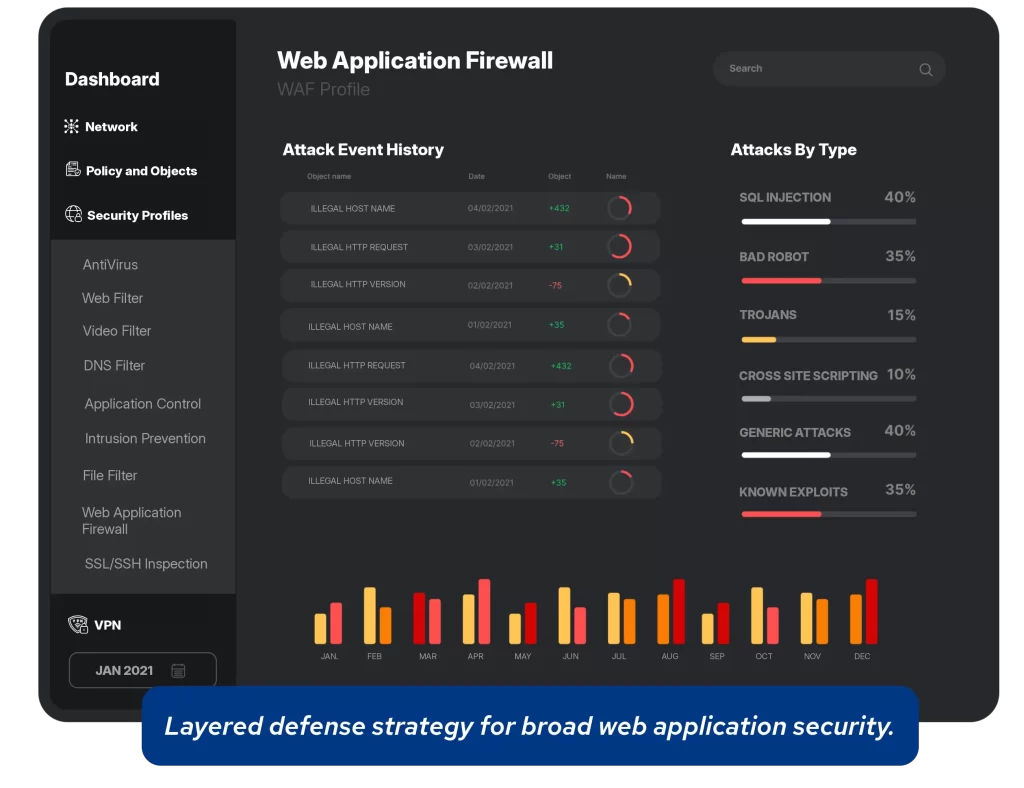
Web Application Firewall
Protect websites, web applications, and APIs from known and emerging exploits with threat intelligence that finds and stops malicious traffic before it reaches servers.
-
SQL Injection Protection
-
Bot Protection
-
DDoS Protection
-
Malware Protection
-
Zero Day Exploit Protection
What is a Web Application Firewall?
The Web Application Firewall inspects incoming HTTP/S traffic at the application layer to detect and block malicious requests to protect web applications in real time. Deployed inline or as a cloud service, it correlates threat intelligence, adapts dynamically based on observed traffic patterns, and provides detailed logging and reporting for rapid incident response.
Real-time threat detection and blocking
Stop attacks as they happen and maintain application availability with advanced analytics, behavioral profiling, threat intelligence, and proactive protection.
Web application layer protection
Block malicious traffic and application-layer attacks from the client-side before they reach backend systems with visibility and rapid response tools to counter emerging attack patterns effectively.
DDoS attack protection
Combat DDoS attacks that overwhelm web applications with malicious traffic by distinguishing legitimate users, blocking or throttling suspicious flows on the application layer.
Bot detection and protection
Allow good bots like search engines and block or divert harmful bots before they can scrape content, carry out credential stuffing, and skew analytics.
API discovery and protection
Defend against API discovery and prevent attackers from mapping an application’s APIs to find endpoints and parameters used for data theft or business logic and service disruption.
Zero-day protection
Block exploit attempts of zero-day attacks before attackers execute code, steal data, or disrupt services, and adapt automatically to new attack techniques.


For Public Sector
For Banking and Insurance
Maintain the confidentiality of account holder information
Banks and insurance companies face threats such as session hijacking, malicious file uploads, and automated bots that scrape data, all of which can expose and exploit financial and personal information. Deploying a positive security model with web application firewalls helps by only accepting inputs that are known to be safe and legitimate, spotting and responding to suspicious activity quickly, limiting data leakage and keeping customer accounts and transactions secure.

For Health and Life Sciences
For Intellectual Property
Protect intellectual property by blocking attacks that try to steal code, designs, or patents from websites and web apps by limiting requests, making it harder for attackers to copy or exfiltrate proprietary information.

Web Application Firewall
Block application-layer threats with web application firewalls deployed at the edge or integrated into your stack.
Web Application Firewall
Lite
best for basic websites without eCommerce, payment capabilities, and stringent security requirements-
Cloud WAF
-
Included in EHS Web Hosting Plans
-
OWASP Core Rule Set
-
SSL / TLS Handling
-
Flexible Rule Customization
-
Fully Managed by EHS
-
24/7 Expert Support
Plus
best for eCommerce and payment processing websites that need firewall protection and PCI-compliance-
Cloud WAF
-
Cisco Talos Real-Time Defense
-
OWASP Core Rule Set
-
Flexible Rule Customization
-
SSL / TLS Handling
-
Global Edge Protection
-
Fully Managed by EHS
-
24/7 Expert Support
Pro
best for websites and web apps that need network + app-layer security and reduced appliance sprawl-
NGFW Cloud WAF
-
Cisco Talos Real-Time Defense
-
OWASP Core Rule Set
-
Flexible Rule Customization
-
SSL / TLS Handling
-
Global Edge Protection
-
Unified Threat Management
-
Deep Packet inspection
-
Application Awareness
-
IPS/IDS Correlation
-
Fully Managed by EHS
-
24/7 Expert Support
Elite
best for enterprise service providers and regulated industries requiring high-availability and granular control-
Cisco Web App Security Ecosystem
-
Enterprise-Grade High Availability
-
Cisco Talos Real-Time Defense
-
OWASP Core Rule Set
-
Flexible Rule Customization
-
SSL / TLS Handling
-
Advanced Bot Protection
-
Global Edge Protection
-
Unified Threat Management
-
Deep Packet inspection
-
Application Awareness
-
Co-managed by EHS
-
24/7 Expert Support
Need a custom-tuned web application firewall?
We offer flexible plans that adapt to a wide range of performance and security requirements.
Frequently Asked Questions
Epcom Hosting Services Web Application Firewall
How reliable is the Web Application Firewall at protecting hosted web applications?
Web Application Firewalls keep web applications safe because they layer several defenses: traffic inspection, behavior analysis, SSL/TLS handling, bot and DDoS mitigation, and rapid incident handling.
What is Cisco Talos and how does it identify newer threats to web applications?
By continuously producing threat detection rules, vulnerability research, developing signatures and heuristics, and incident response guidance, the Talos threat intelligence and research group directly enhances Cisco web application firewalls, intrusion prevention systems, and endpoint defenses, so it can effectively block known and emerging application-layer attacks and keep web applications and APIs protected from the latest exploitation techniques.
Is the Web Application Firewall available as a cloud service or as a physical appliance?
Available in physical and cloud-native deployments, our web application firewall is a comprehensive security stack comprising of Cisco Web Application Firewall appliances and edge network devices that provide stringent network-level protection for enterprise applications, APIs, web portals, and microservices.
What is the role of the OWASP Core Rule Set in protecting web applications?
The OWASP Core Rule Set (CRS) is a set of ready-made rules that help detect and stop common web and API attacks. It works by normalizing and inspecting incoming requests, using proven signatures and threat scores to block malicious traffic while keeping false positives low. Maintained and updated by the OWASP community, the CRS adapts to new attack methods and evolving threat behaviors. Organizations can customize the rules to match their policies, application logic, and risk tolerance, and it can be used with an implemented web application firewall cloud service or appliance to strengthen layered security and support compliance.
What is NGFW and why is it better than traditional web application firewalls?
An NGFW (next-generation firewall) filters network traffic, stops intrusions, understands applications, and uses user identity to protect the whole network, application, underlying code, and API. A cloud web application firewall watches and protects web apps from HTTP/S attacks and other common OWASP threats while NGFWs dig deeper into application traffic, applying temporary fixes (virtual patches), and blocking bad bots and unsafe API calls—things a traditional cloud WAF can’t secure. Many organizations use NGFW for perimeter and internal network defense and for detailed, app-focused protection.